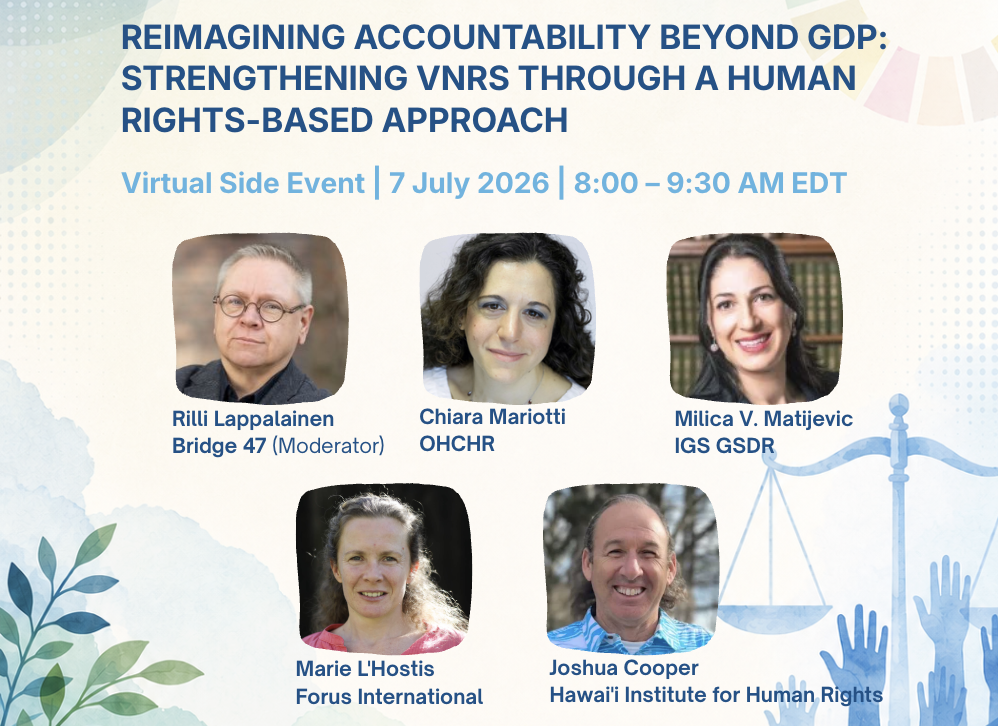
Accountability Beyond GDP: Strengthening Voluntary National Reviews through a Human Rights-Based Approach
As the international community approaches the final years of the 2030 Agenda, fundamental questions remain about how sustainable development progress is measured, reviewed and translated into meaningful action.
These questions were at the centre of the online event “Accountability Beyond GDP: Strengthening VNRs through a Human Rights-Based Approach,” organized by the UNECE Regional Civil Society Engagement Mechanism in the context of the 2026 High-level Political Forum on Sustainable Development.
The discussion brought together representatives of the United Nations, academia and global civil society to explore how Voluntary National Reviews can move beyond statistical reporting and become more credible, inclusive and consequential accountability mechanisms.
The event was moderated by Rilli Lappalainen, CEO of Bridge 47. Opening the discussion, Dr. Nelya Rakhimova, member of the UNECE-RCEM Governing Body and lead of the Major Groups and Other Stakeholders VNR Task Group, emphasized the important role that VNRs play in shaping national implementation of the 2030 Agenda.
She noted that national reviews frequently concentrate on statistical indicators while overlooking structural inequalities, human rights violations, civic space and the lived experiences of people and communities. Civil society, she stressed, is often uniquely positioned to provide this missing evidence and ensure that progress is examined through a human rights-based lens.
Moving beyond economic growth as the primary measure of progress
Chiara Mariotti, Development Economist and Human Rights Officer at the Office of the UN High Commissioner for Human Rights, reflected on the relationship between VNRs, human rights and the growing international discussion on measures beyond gross domestic product.
While VNRs have gained considerable legitimacy and created an important space for governments to discuss SDG implementation, their current limitations often mirror the limitations of GDP itself. National averages can hide inequality, discrimination, unpaid care work, informal employment, environmental damage and major differences in well-being between population groups.
Moving beyond GDP therefore requires more than simply adding new indicators. Measurement systems should help determine who benefits from development, who is being left behind, what environmental and social costs are being created, and whether governments are using their maximum available resources to fulfil human rights.
A human rights-based approach can strengthen such systems by focusing not only on outcomes, but also on equality, participation, policy effort, resource allocation, accountability and access to remedy.
Connecting SDG reporting with existing human rights obligations
Milica Matijević, Senior Research Fellow at the Institute of Comparative Law in Belgrade and member of the Independent Group of Scientists preparing the 2027 Global Sustainable Development Report, argued that the relationship between the SDGs and international human rights standards must become operational rather than merely declaratory.
Most UN Member States have already accepted extensive obligations under international human rights law. Governments should therefore connect their SDG reporting directly with recommendations received from the Universal Periodic Review, UN treaty bodies, special procedures and other human rights mechanisms.
VNRs should explain how these recommendations have influenced legislation, public policy, budgeting and institutional reform, rather than simply cross-referencing human rights documents.
Matijević also highlighted the importance of procedural rights, including access to information, transparency, inclusive participation and access to legal or other forms of remedy. These standards provide practical tools through which civil society can challenge harmful policies and development decisions.
Greater investment is consequently needed to strengthen the ability of civil society organizations to use national, regional and international accountability mechanisms.
Bridging global commitments and local realities
Drawing on grassroots and Indigenous advocacy, Joshua Cooper, academic, human rights educator and activist based in Hawai‘i, emphasized that communities must be treated as rights holders and knowledge holders, rather than merely as sources of testimony.
He stressed the importance of linking VNRs with the Universal Periodic Review and other human rights processes, while making recommendations understandable and accessible to communities. Civil society participation should include public education, community consultations, engagement with governments and sustained follow-up after reviews have been completed.
Cooper also called for stronger links between international, national and local accountability. Voluntary Local Reviews and local human rights reviews can help translate international commitments into action by municipalities, regional authorities and other institutions closest to affected communities.
Indigenous peoples and island communities, he noted, bring essential knowledge about collective well-being, environmental protection and intergenerational responsibility. Their perspectives can help challenge development models centred primarily on profit and economic growth.
From presentation to correction
Marie L’Hostis, Head of Advocacy and Programmes at Forus, presented lessons emerging from national NGO platforms and regional civil society coalitions across the world.
VNRs have generated valuable opportunities for dialogue, policy alignment and peer learning. However, reporting alone does not create accountability. Reviews often remain selective, government-led narratives of progress, with limited independent scrutiny and weak follow-up.
L’Hostis argued that review processes must move from presentation to correction. A credible review should identify implementation gaps, policy trade-offs, risks and reversals. It should also determine whether institutions, public policies and budgets are sufficient to meet stated commitments—and specify what must change when they are not.
Official statistics remain essential, but they must be complemented by disaggregated data, civil society shadow and spotlight reports, citizen-generated data, independent monitoring and local knowledge. These sources are particularly important when official reporting is incomplete or sensitive issues are underreported.
Participation must also extend throughout the entire review cycle. Civil society and local actors should be involved in setting priorities, identifying evidence gaps, reviewing drafts, contributing analysis and monitoring follow-up. Their participation must be safe, adequately resourced and supported by clear institutional entry points and public feedback.
L’Hostis outlined three priorities for the future accountability architecture:
- Establish regular and universal reviews based on common minimum standards, human rights and independent evidence.
- Institutionalize meaningful, safe and properly resourced participation by civil society and local actors.
- Ensure that every review results in a public follow-up plan identifying gaps, responsibilities, policy measures, budgets and timelines.
Redesigning accountability around people
In her closing synthesis, Sylvia Beales, member of the UNECE-RCEM Governing Body, emphasized that measurement must be participatory, transparent and accountable.
Those most affected by poverty, exclusion, discrimination and environmental harm must have a voice in deciding what progress means and how it should be assessed.
She highlighted a persistent accountability gap:
Reporting without correction, participation without influence and commitments without follow-up do not constitute accountability.
In contexts marked by shrinking civic space, conflict, intimidation or reprisals, the absence of critical voices must never be interpreted as public agreement. Silence is not legitimacy.
For VNRs to function as meaningful accountability mechanisms, they must demonstrate not only what progress has been achieved, but how evidence has influenced policy priorities, institutional decisions and resource allocation.
The discussion also highlighted the importance of connecting national reviews with local realities, strengthening cooperation between ministries, statistical offices and national human rights institutions, and building civil society capacity to use existing human rights mechanisms.
Looking towards the post-2030 framework
The emerging discussion about development beyond GDP and the future of the global sustainable development framework presents a rare opportunity to rethink accountability.
This is not simply a technical debate about indicators. It is a political discussion about whose evidence counts, whose realities are recognized and who has the power to define progress.
Participants agreed that the existing sustainable development and human rights systems already provide important foundations. The challenge is to create stronger institutional connections, meaningful follow-up and sufficient political will.
A future accountability architecture must place people, human dignity, equality, environmental sustainability and human rights at its centre.
As the moderator concluded:
Reviews without independent evidence are incomplete. Participation without influence is not meaningful. Commitments without follow-up are not accountable.
These principles should guide both the remaining years of implementation of the 2030 Agenda and the design of the global framework that follows it.