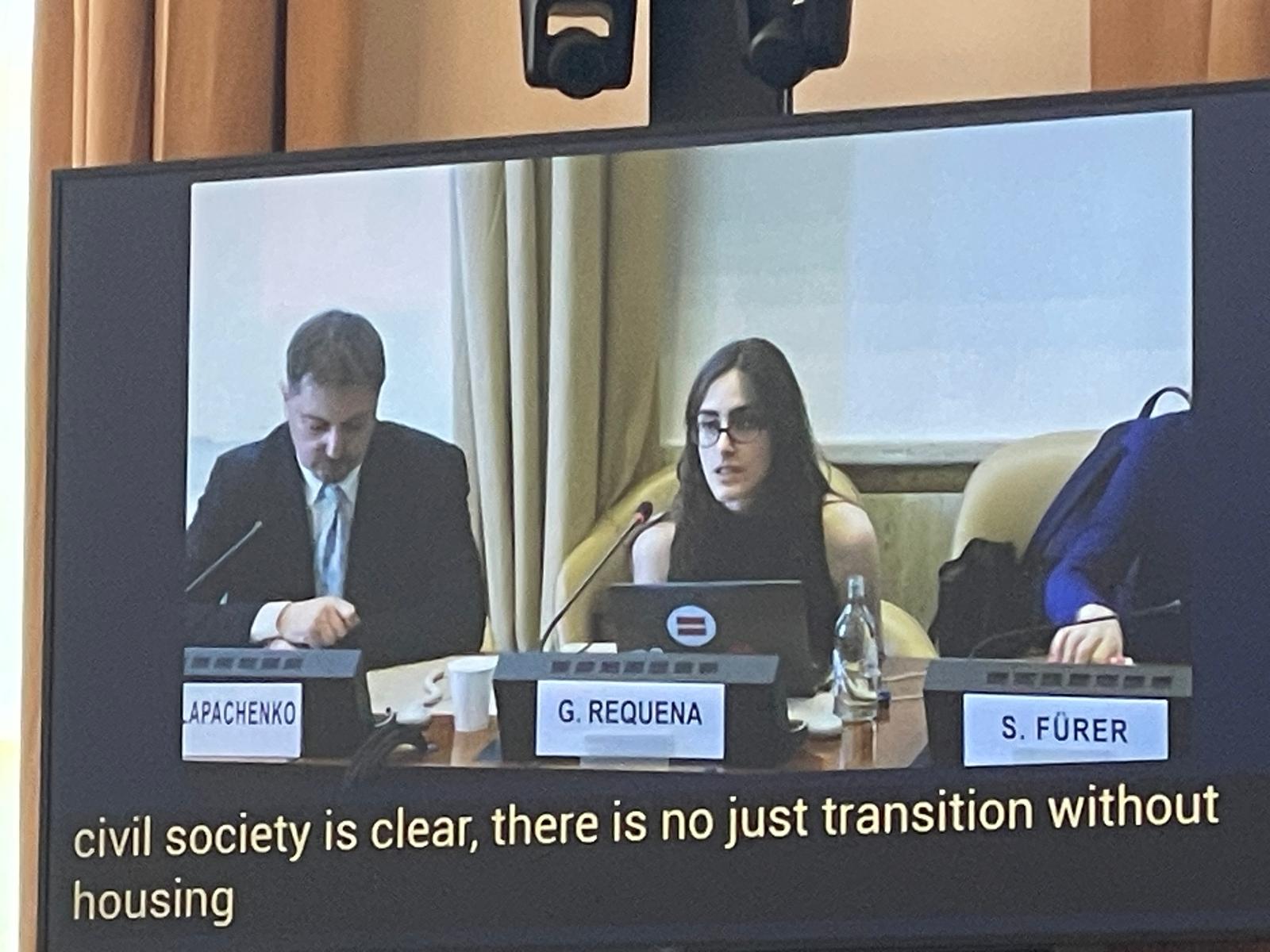
Delivered by Geda Requena
Thank you, Chair.
I speak on behalf of the Civil Society Regional Mechanism, representing constituencies across the UNECE region.
In addressing how cities can advance a just transition, particularly through the housing crisis, our message is clear: there is no just transition without housing justice. The housing crisis in our cities is not inevitable—it is the outcome of policy choices, and it can be reshaped through different choices grounded in rights, equity, and sustainability.
Across the region, housing is still too often treated primarily as a financial asset rather than a fundamental human right and a pillar of a fair transition. This has led to deepening inequalities: a persistent shortage of social and affordable housing, rising rents, and growing insecurity for households already under pressure from climate, economic, and social change.
Informal settlements are part of this reality, not as temporary exceptions but as structural outcomes of exclusion. They are often home to marginalized communities, including migrants and Roma populations, who continue to face insecure tenure, limited access to services, and exposure to forced evictions. These conditions are incompatible with a just transition.
At the same time, many groups remain excluded from how cities are planned and transformed—older persons, persons with disabilities, migrants, minorities including Roma communities, women, and LGBTI persons. A just transition in housing requires urban planning that is explicitly intersectional, ensuring that climate adaptation, energy efficiency upgrades, and redevelopment do not reproduce or deepen existing inequalities.
We also see a mismatch between short-term, market-driven housing development and the long-term needs of people and cities. Too often, housing policy does not adequately respond to demographic change, social needs, or the climate crisis—including the need for energy-efficient, resilient, and affordable homes.
And yet, solutions are well known.
The Housing First approach, as demonstrated in Finland, shows that homelessness can be significantly reduced through sustained public investment and a rights-based framework. Across the region, cooperative and community-led housing models also demonstrate how affordability, inclusion, and sustainability can be achieved together.
The challenge is not identifying what works—it is scaling it, financing it, and embedding it within a just transition framework.
From a civil society perspective, we highlight three priorities for cities:
First, anchor housing policies in the recognition of housing as a human right, including stronger tenant protections, anti-displacement measures, and effective regulation of speculative markets.
Second, invest in social and affordable housing as a core component of the just transition, ensuring long-term planning that integrates social equity, climate resilience, and energy efficiency.
Third, ensure meaningful participation of affected communities in all housing and urban transformation processes, so that those most impacted by the transition are also shaping it.
A just transition in cities cannot succeed without housing that is secure, affordable, inclusive, and sustainable. Housing is not only shelter—it is a foundation for dignity, resilience, and social cohesion.
Thank you.
(follow up question asked of Geda on intersectionality. Reply was no successful implementation of SDG 11 without intersectional approaches and measurement.)
Thank you, Chair.
I speak on behalf of the Civil Society Regional Mechanism, representing constituencies across the UNECE region.
In addressing how cities can advance a just transition, particularly through the housing crisis, our message is clear: there is no just transition without housing justice. The housing crisis in our cities is not inevitable—it is the outcome of policy choices, and it can be reshaped through different choices grounded in rights, equity, and sustainability.
Across the region, housing is still too often treated primarily as a financial asset rather than a fundamental human right and a pillar of a fair transition. This has led to deepening inequalities: a persistent shortage of social and affordable housing, rising rents, and growing insecurity for households already under pressure from climate, economic, and social change.
Informal settlements are part of this reality, not as temporary exceptions but as structural outcomes of exclusion. They are often home to marginalized communities, including migrants and Roma populations, who continue to face insecure tenure, limited access to services, and exposure to forced evictions. These conditions are incompatible with a just transition.
At the same time, many groups remain excluded from how cities are planned and transformed—older persons, persons with disabilities, migrants, minorities including Roma communities, women, and LGBTI persons. A just transition in housing requires urban planning that is explicitly intersectional, ensuring that climate adaptation, energy efficiency upgrades, and redevelopment do not reproduce or deepen existing inequalities.
We also see a mismatch between short-term, market-driven housing development and the long-term needs of people and cities. Too often, housing policy does not adequately respond to demographic change, social needs, or the climate crisis—including the need for energy-efficient, resilient, and affordable homes.
And yet, solutions are well known.
The Housing First approach, as demonstrated in Finland, shows that homelessness can be significantly reduced through sustained public investment and a rights-based framework. Across the region, cooperative and community-led housing models also demonstrate how affordability, inclusion, and sustainability can be achieved together.
The challenge is not identifying what works—it is scaling it, financing it, and embedding it within a just transition framework.
From a civil society perspective, we highlight three priorities for cities:
First, anchor housing policies in the recognition of housing as a human right, including stronger tenant protections, anti-displacement measures, and effective regulation of speculative markets.
Second, invest in social and affordable housing as a core component of the just transition, ensuring long-term planning that integrates social equity, climate resilience, and energy efficiency.
Third, ensure meaningful participation of affected communities in all housing and urban transformation processes, so that those most impacted by the transition are also shaping it.
A just transition in cities cannot succeed without housing that is secure, affordable, inclusive, and sustainable. Housing is not only shelter—it is a foundation for dignity, resilience, and social cohesion.
Thank you.
(follow up question asked of Geda on intersectionality. Reply was no successful implementation of SDG 11 without intersectional approaches and measurement.)